Repairability
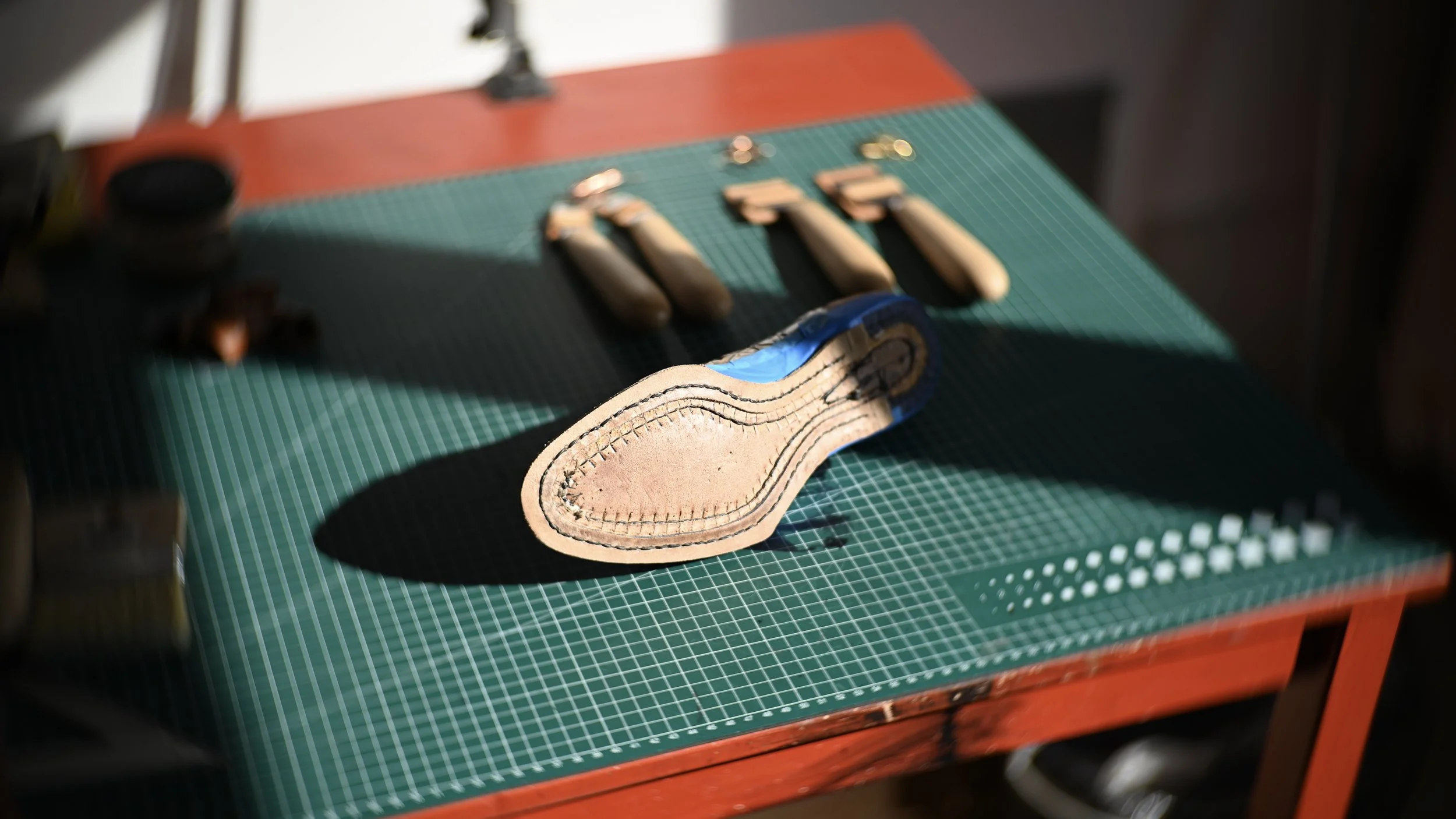
Whoever came up with this construction method was a genius. A hand-sewn welt guarantees the reliability and longevity of such pair of shoes.
Perhaps a natural step in defining quality in footwear is the idea of breaking down shoes into individual components again. The need to verify my own quality even led me to create a pair specifically designed for reassembly, simulating a deep repair, like a full resole job.
Of course, such a simulation is more of a play on the idea, as nothing can replace the actual wear and tear of a product over the years. Only through natural wear can we assess aspects such as the durability of the construction and verify the correctness of the solutions implemented. Unlike the properties of the materials themselves, these issues remain quite mysterious at an early stage.
The situation changes only after developing our own standards. Testing them in practice allows for selection, which is why standardization has recently become so important to my thinking. Although implementing individual designs from the outset is the only option for me, developing a unified set of shoe construction techniques directly translates into both quality and the development of a personal footwear style. Originality is one of the most important product characteristics for me.
I also attach importance to consistency of quality. Designing individual styles is incredibly exciting, but if it translates into using slightly different construction techniques each time, I deprive myself of the opportunity to verify the quality of my work. In a sense, this is a convenient cover for a perhaps bitter truth.
Standardizing my work serves as a way to overcome this fear. Will I be able to make several pairs the same way while maintaining quality and production levels? I intuitively feel that sooner or later I have to take it on. Like any other craft, the longer you engage in a task, the more you realize its complexity. And worst of all, you eventually hit the wall of your own limitations.
I dread that moment because it reminds me of the loss of innocence. The comfort of gaining experience eventually turns into an attempt to find excuses. The only solace in confronting one's own limitations is the process of improvement. While some fundamental limits cannot be killed, one can certainly focus on perfecting tough issues. However, I wonder if the people whose work I admire ever achieve the soothing satisfaction in their shoemaking. I'm not sure if my mental abilities will allow me to overcome my obsession with perfection.
As of today, as part of my search for a standard, I'm confident about the forefoot. I want to use welted construction there and have developed a standard for its look in the finished product. I think I'm close to achieving the same with the heel section, though there are still a few elements I'm not entirely sure about. The biggest unknown for me remains the construction of the waist. Currently, this area is in the trial and error phase. I think I'm pretty close with the look, but the technical aspect remains open to me for now.
While working on systematizing my production process, I discovered a method for overcoming a challenge that had previously discouraged me from making any repairs. As a manufacturer of new shoes, the moment they are removed from the last is a turning point for me, a moment when I consider my work complete.
I recently replaced the top lift of the heel for one of my first customers, which led me to develop a method for re-lasting the shoe that would be sufficiently effective for me. Each pair of my shoes is equipped with shoe trees made according to the last shape. I keep a working pair of these trees, and by installing a sort of lock, I transform the trees into lasts. It's a solution that's brilliant in its simplicity.
The method works perfectly. It allows for a completely non-invasive reset. In the blink of an eye, finished shoes can turn into a new pair in production. From my perspective, this is a psychological thing, but from a technical perspective, it makes any repair more thorough. For example, the ability to hammer the upper or sole with this method allows for the reversal of wear and tear to some degree.
This episode, along with the fact that I recently had to deal with repairs while working for a Warsaw workshop, reoriented my cognitive apparatus. Now, when I begin working on a piece, I look to the future and try to analyze its repair options. In a sense, this opens a new chapter in my professional practice.