Three Generations
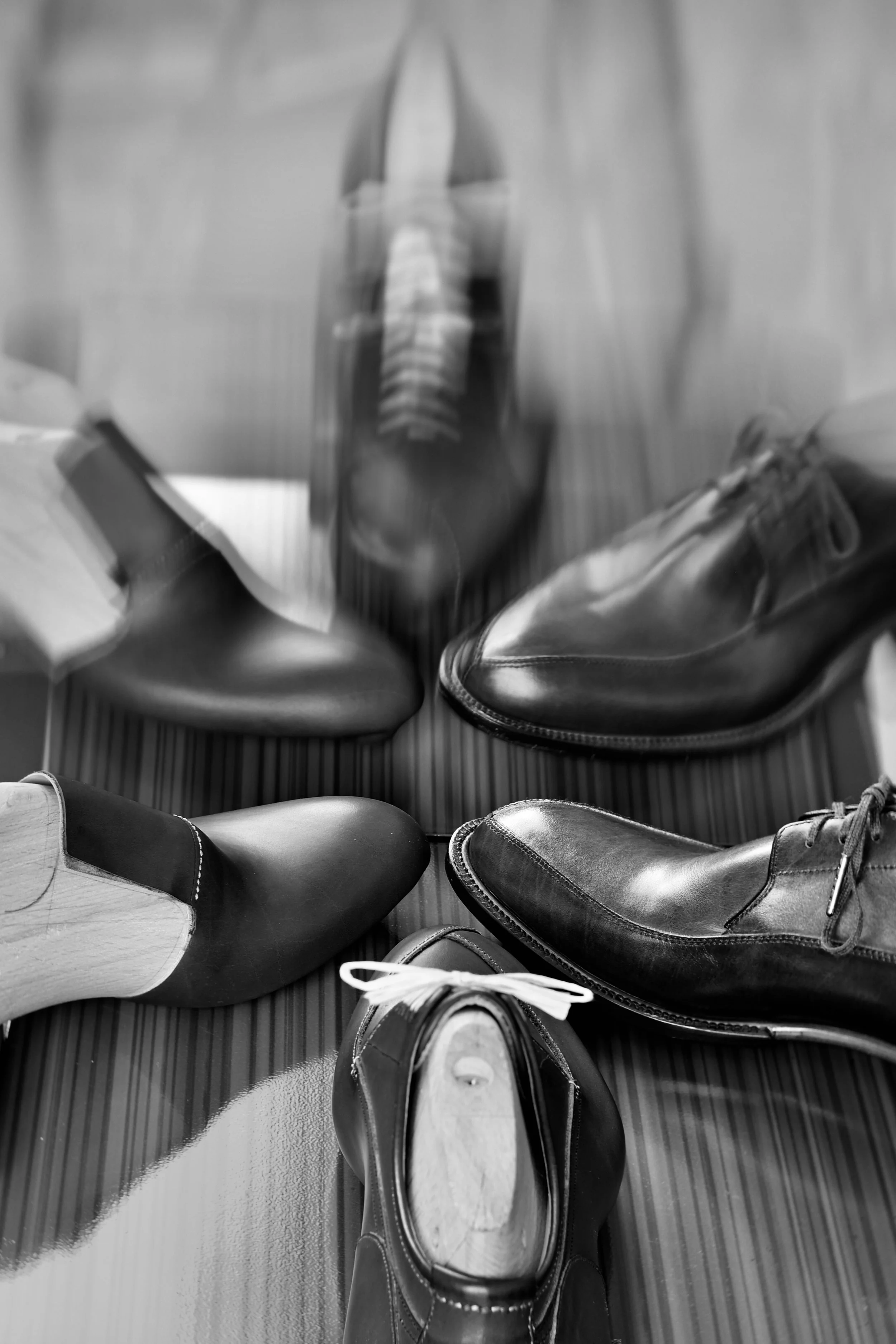
I'm very happy with this photo. I want to explore this effect further in the future. Another lucky break in my career!
You're already familiar with the first prototype of this design, as it appears almost everywhere on this site. I wanted to incorporate the lines of the facing that I admired from my Japanese colleagues.
However, I wouldn't be myself if I didn't add a touch of originality. I wondered: why not simultaneously utilize the sweeping lines known from balmoral design? All I had to do was to add a signature element of my style, a teardrop-shaped heel counter, and solve the problem of designing a toe that would elegantly complement the whole. Et voila!
This line of thinking resulted in a single design session, directly on the last. I was so satisfied with the lines at the time that I immediately began to cutting out my test patterns.
Everything seemed to be working just fine. I consulted the results with the client, who lively confirmed my intuitions. The production machine was set in motion, and thus I produced the first prototype. That sample shoe was finished to a standard that deceptively suggested the actual pair. Indeed, both my colleagues and the client himself were under the impression they were looking at the finished shoe! Like a half-realization of the final pair already.
The subsequent scenario, though, was written for me by a regime of hard work as a shoemaker with two jobs. I was handing out an average of three or four pairs a month to Warsaw, leaving change in my pocket, which I could only spend on occasional relaxation. Time flew by, and with it, I looked with an increasingly cold eye at my dusty prototype, patiently awaiting completion in the queue of projects.
In a burst of enthusiasm, at some point I decided to go wild and slightly redesign that original vision.
This was also because I had the opportunity to walk around in the shoe in the meantime, which fueled the artillery of questions that demanded a decisive salvo of answers. In these circumstances, I began to think about this whole thing again.
Enough time had passed to approach the project completely anew. Furthermore, I discovered minor adjustments that I should apply to the lasts themselves. For these reasons, the old templates had to be discarded.
The second design session was just as spontaneous as the first. Typical of something that has already become dated, it was characterized by a desire to simplify the lines. Although I didn't stray too far from the original. Remember, the client had already approved the initial version of it.
In this atmosphere, the second prototype, for which I've already shown you the upper, is being created now. I intend to bring it to a fully functional state, also because this will allow me to obtain a full pair to verify the adjustments I made to the last. So, the right shoe will document approach number one, and the left approach number two. Plus a better fit.
I’ll show you how this odd pair looks like after I’m done. The making of which also fueled my third part for the Tutorials page. It’s about the stiffeners and the way I approach this important stage of shoemaking process. I’m currently writing a piece regarding the topic, so expect a new post on April Fool’s Day.
As you can imagine, working on the second prototype gave me the opportunity to look at the project from a different perspective. At this point, I want to move on to the most important part of this post. My third prototype for this project, emerging before your eyes here, is the result of a sudden reflection that occurred to me while assembling the upper for the second prototype. Why are we so attached to symmetry in shoemaking? I asked myself this question. I’m looking for a good answer.
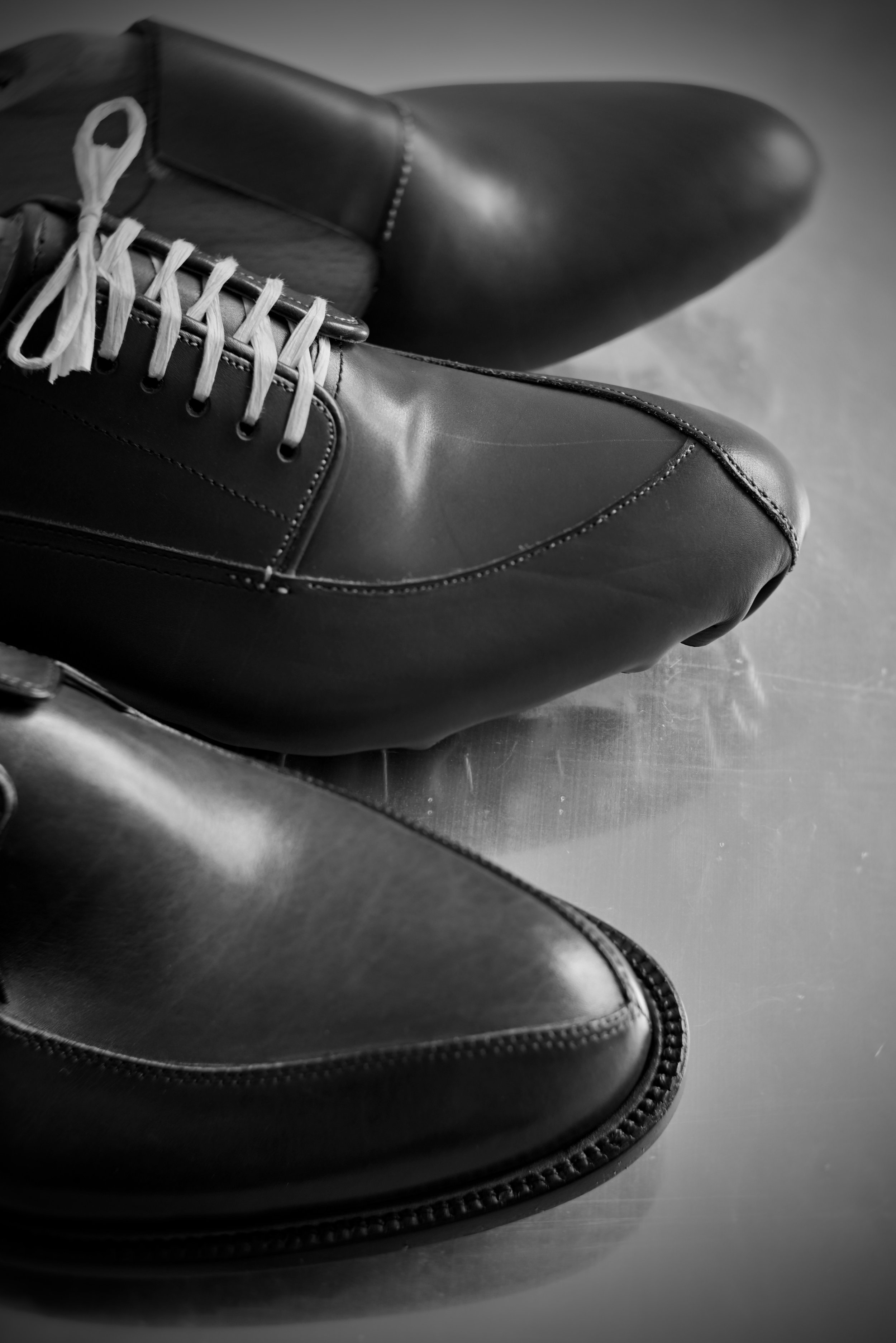
The first prototype, the upper of the second and the third on the way...
Of course, symmetry is something we enjoy. We look for it everywhere. Even though, paradoxically, it's practically nonexistent in nature.
In the case of shoes, I want to see what happens when I design the lateral part of the upper in contrast to the medial part. Counterpoint in music is something incredibly delicious, provided it's incorporated skillfully. I want to act like a talented composer.
I intend to accomplish this task using the following formula: the outer part of the upper will be designed somewhat more in line with the first design. I want to juxtapose the spirit of this technically rather complex side with the pure form of the medial side, which will evoke the feel known from wholecuts. In other words: a series of intersecting lines against a smooth, almost plain surface.
If this little experiment yields satisfactory results, I'm considering introducing this unconventional element of surprise as a permanent feat defining my upper design style. Perhaps it will spice up my pairs. However, this method may as well turn out to be an attempt to force open a door ajar and a complete failure. Nevertheless, we’re gonna find out soon enough.