Towards Simplicity
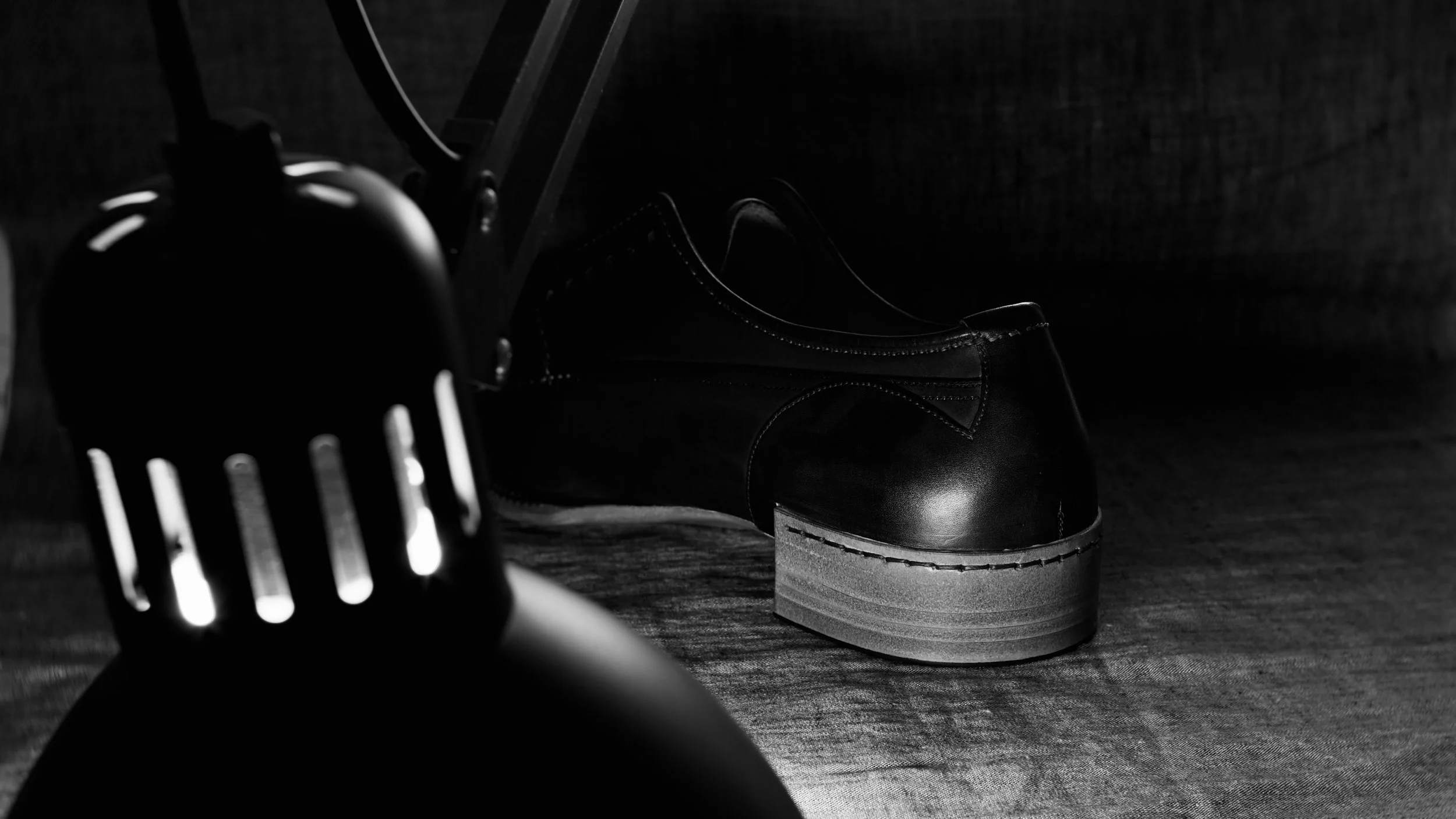
Inspired by the beautiful lines of Tadeusz Januszkiewicz's heels, I achieved the desired effect, but in my own way.
I'm feeling a sense of satisfaction as I see a transformation in my perception of shoemaking. This transformation is a necessary step if I'm ever destined to become not only original, but also simply a good craftsman. Knowing myself and the level of my skills, I knew this new phase would come. I patiently awaited it. At the very end of 2025, I finally began to feel it.
The signals were subtle, as they often are in such matters. It really began with a little bit more intense thoughts considering how to join the upper elements and finish their edges. On these occasions, I began to note an increasing number of "no's." I felt that the stage of implementing merely rough ideas was coming to an end. My approach to design gradually matured.
Having made about a hundred pairs so far, I humbly agree with Daniel Wegan's words. You have to get through the whole production process fifty to a hundred times to understand whether shoemaking is truly for you. After all this work, I'm looking at shoes with a different perspective. I'm going back to the basics. To the classics. To proven solutions.
At the same time, I'm very pleased with the process itself. It's both a privilege and the Achilles' heel of being a self-taught artisan.
A privilege because by independently discovering methods for literally everything, you gain a deeper understanding of why a given solution works or doesn't.
A weakness because such a process significantly slows down your development because you don't have anyone around you who has been through the same thing before and already knows the answers. Therefore, it takes longer to reach the threshold that you can then confidently cross.
But in this field, there's no silver bullet. You can, of course, find simply a bad teacher. Not only will you fail to define your own style in the craft, but you'll also give up after such a disastrous experience.
As a self-taught craftsman, you have to manage on your own, but you also carefully listen to your intuition and heart. With such a guide, nothing bad can happen, and whether you become a professional depends entirely on your own talent. And a bit of luck too.
2026 is a breakthrough in these respects for me. I'm beginning to respect the lines and proportions even more, and consciously choose construction techniques that will work. I feel I can now start working with better quality leathers. I'm one big step closer to my goal.
My visions, both in my dreams and in my waking life, have also evolved significantly. I now see smoother transitions, more dynamic last shapes, bold upper lines...
All of this revolves around wholecuts. I feel like the trend towards reducing the number of parts for the upper is becoming stronger. Also much more often, during my design sessions, I take the likelihood of successfully executing what I have in mind into account.
Analyzing these elements, I feel like the pieces are starting to fit together. It's a beautiful feeling that gives me strength and opens a completely new chapter in my professional career.
The question arises. Why now? This is a fundamental one. It touches on the most basic issues. It's about a conscious approach to developing professional skills. The very idea of inventing yourself.
Like some of my colleagues, I'm a tinkerer by nature. From a young age, I enjoyed tinkering with toys, taking them apart. Years later, I realized that I'd always been fascinated by how the objects around me were made. The act of creation consumed me, but it took me a long time to come to terms with the fact that art is not my destiny. My mind is technical, concrete, absorbed in matter. The same is true in my professional life.
In my inner life, I'm equally absorbed in a completely opposing world. In this sphere, my reasoning is very metaphysical. These two wolves reside in my soul. And this is the source of my creativity.
I would consider it a complete failure to work according to a pre-determined pattern. Therefore, classic simplicity is not my natural habitat. I invent methods. I don't learn them from others, rigidly applying them. It's a very crude difference.
This makes simplicity a challenge for me. I appreciate classic lines, structures, and so on. On the other hand, in practice, it imposes a certain rigor and sooner or later condemns to routine. And I've already spoken quite bluntly about routine at work in my previous posts.
It looks like this year is shaping up to be an exceptionally creative one for me. I have a lot of work to do, but I can't wait to get my hands on it. This year already presents itself as a time of many breakthroughs in my career.